

Updated 3 weeks ago
What Are Food-Grade Packaging Materials? A Guide for Food Brands
Fast Sincere

Food packaging does more than contain and display a product. Materials that come into contact with food must be suitable for their intended use, while the finished packaging should provide the protection, strength, and sealing performance required throughout distribution and storage.
Food-grade packaging materials include suitable plastic films, paper-based structures, coatings, adhesives, and other materials used in food-contact applications. However, not every grade of these materials is automatically appropriate for direct food contact.
For food brands and manufacturers, understanding material properties, regulatory requirements, and packaging construction is essential when developing safe and reliable flexible packaging.
What Are Food-Grade Packaging Materials?
Food-grade packaging materials are generally understood as materials suitable for contact with food under specified conditions of use.
The more precise regulatory term is food contact materials (FCMs), which covers materials and articles intended to come into contact with food, including packaging bags, containers, films, and certain processing equipment.
Food-contact suitability depends on several factors:
- Material Composition: The polymers, additives, coatings, inks, and adhesives used in the packaging structure.
- Food Type: Whether the packaged product is dry, aqueous, acidic, fatty, or otherwise sensitive.
- Contact Conditions: The temperature and duration of contact between food and packaging.
- Chemical Migration: The potential transfer of substances from packaging components into food.
- Manufacturing Control: Production practices that help maintain consistent material quality and minimize contamination.
A material suitable for packaging dry biscuits at room temperature may not be appropriate for hot filling or prolonged contact with fatty foods.
Food-contact compliance must therefore be evaluated according to the actual material structure and intended application.
Common Types of Food-Grade Flexible Packaging Materials
Flexible food packaging commonly uses polymer films and combinations of materials selected for their mechanical, optical, barrier, and sealing properties.
1. BOPP (Biaxially Oriented Polypropylene)
BOPP is a widely used packaging film produced by stretching polypropylene in two directions.
It is valued for its clarity, stiffness, dimensional stability, and printing performance.
Key Characteristics
- Good optical clarity for transparent packaging designs.
- Suitable surface for printing and lamination when properly treated.
- Useful moisture barrier properties for many dry food applications.
- Good stiffness for certain structured flexible packaging formats.
- Available in different grades and surface finishes.
Food-contact-suitable BOPP grades can be used in packaging for biscuits, candies, bakery products, snacks, and other dry foods.
In laminated packaging, BOPP frequently serves as an outer printable layer, while a separate sealant layer provides the required heat-sealing properties.
2. CPP (Cast Polypropylene)
CPP is a polypropylene film manufactured using a cast-film process.
Compared with oriented polypropylene, CPP generally offers different flexibility and heat-sealing characteristics, making it useful as a sealing layer in compatible flexible packaging structures.
Key Characteristics
- Heat-sealing performance in suitable formulations.
- Good flexibility and resistance to certain mechanical stresses.
- Available in transparent and specialized grades.
- Compatible with selected polypropylene-based packaging laminates.
- Suitable for a range of food packaging applications.
CPP is often combined with BOPP or other appropriate materials to create packaging structures that balance printability, strength, and sealing performance.
The required CPP grade depends on the filling process, seal specifications, and intended food-contact conditions.
3. PE (Polyethylene)
Polyethylene is one of the most widely used polymer families in flexible packaging.
Different PE grades offer varying levels of flexibility, toughness, sealing behavior, and puncture resistance.
Key Characteristics
- Flexible structure suitable for many packaging formats.
- Heat-sealing performance in appropriately selected grades.
- Useful moisture barrier characteristics.
- Available in different density and formulation options.
- Can serve as a sealant layer in multilayer packaging.
PE-based materials are commonly considered for snacks, dry foods, frozen foods, and other applications, depending on the specific film grade.
Their suitability for hot filling, frozen storage, or other specialized conditions must be verified separately.
4. PET (Polyethylene Terephthalate)
PET film offers good dimensional stability, mechanical strength, and printing characteristics.
In flexible food packaging, PET is often used as an outer layer within a multilayer laminate.
Key Characteristics
- Good tensile strength and dimensional stability.
- Suitable printing and lamination properties.
- Transparent appearance in standard clear-film grades.
- Resistance to certain mechanical and handling stresses.
- Useful performance in appropriately engineered multilayer structures.
PET may be combined with PE, CPP, or other materials to achieve specific packaging performance requirements.
The finished laminate’s barrier properties depend on its complete construction rather than PET alone.
5. Kraft Paper and Paper-Based Packaging
Kraft paper is often selected for its natural appearance, printable surface, and distinctive tactile qualities.
It is used in food packaging designs for bakery products, coffee, tea, nuts, and other dry goods.
Key Characteristics
- Natural paper texture and appearance.
- Suitable for customized printing and decorative finishes.
- Available in different weights and grades.
- Can be combined with compatible films or coatings.
- Useful for various structured packaging bag designs.
Paper itself does not necessarily provide sufficient grease resistance, moisture protection, or heat-sealing performance for every application.
Where additional properties are required, paper-based packaging may incorporate coatings, sealing layers, or laminated films.
Only suitable grades and completed structures should be used for the intended food-contact conditions.
Food Packaging Material Comparison
| Material | Main Advantages | Common Packaging Function |
|---|---|---|
| BOPP | Clarity, stiffness, printability, moisture resistance | Printable outer layer, transparent packaging |
| CPP | Flexibility, heat sealability | Inner sealant layer |
| PE | Flexibility, toughness, sealing performance | Sealant layer, flexible packaging film |
| PET | Strength, dimensional stability, printability | Outer structural and printing layer |
| Kraft Paper | Natural appearance, printability | Paper-based packaging surface |
Material properties vary by grade, thickness, additives, and processing conditions. The table provides general guidance rather than a guarantee of suitability for every food application.
Food-Contact Safety Standards and Compliance
Food brands should evaluate packaging materials against the regulations applicable to their target markets.
Different countries and regions have their own requirements for food-contact substances, manufacturing practices, and supporting documentation.
FDA Food Contact Requirements in the United States
In the United States, the Food and Drug Administration regulates substances used in food-contact applications under the applicable legal framework.
The regulatory status of a substance may be established through an applicable food additive regulation, an effective Food Contact Notification, or another recognized regulatory basis.
The permitted use may specify particular food types, temperatures, and contact conditions.
It is important to distinguish between materials that have an appropriate regulatory basis for a defined use and finished packaging products described broadly as “FDA certified.”
FDA compliance should be supported by relevant material information and the applicable regulatory provisions, rather than a generic claim that every packaging bag is FDA approved.
EU Food Contact Regulations
In the European Union, Regulation (EC) No 1935/2004 establishes the general safety requirements for food-contact materials.
Commission Regulation (EU) No 10/2011 establishes additional requirements for plastic food-contact materials and articles within its scope.
These requirements address matters such as authorized substances, composition restrictions, migration limits, and compliance documentation.
Food-contact materials must also be manufactured in accordance with applicable Good Manufacturing Practice requirements.
For plastic food-contact materials, a Declaration of Compliance and appropriate supporting documentation are important parts of the compliance process.
Understanding Migration Testing
Migration testing evaluates the potential transfer of substances from packaging materials into food or suitable food simulants.
Testing conditions are selected according to the intended food type, contact time, and temperature.
Two commonly discussed concepts are:
- Overall Migration: The total amount of non-volatile substances transferred under specified test conditions.
- Specific Migration: The amount of a particular substance transferred, evaluated against any applicable restriction.
Migration testing helps evaluate whether a packaging structure meets relevant requirements for its intended application.
A passing result under one set of conditions does not automatically establish suitability for every possible use.
How to Choose Food-Grade Packaging Materials
Selecting appropriate materials requires balancing regulatory compliance with the packaging performance required by the food product.
Consider the Type of Food
Different foods interact with packaging materials in different ways.
Dry biscuits and crackers may prioritize moisture protection. Nuts and roasted coffee can require additional oxygen protection, while fatty foods may introduce different material-compatibility considerations.
Material suitability should be assessed using the actual food category and intended storage conditions.
Evaluate Moisture and Oxygen Barriers
Moisture and oxygen transmission can affect the quality of packaged foods.
Two common packaging performance measurements are:
- WVTR (Water Vapor Transmission Rate): Used to evaluate the transmission of water vapor through packaging materials.
- OTR (Oxygen Transmission Rate): Used to evaluate oxygen transmission under defined test conditions.
Lower transmission rates may be beneficial for products requiring higher protection, but the required values depend on the food and shelf-life objectives.
Verify Heat-Sealing Performance
Heat-sealing properties influence packaging integrity and compatibility with production equipment.
Important considerations include sealing temperature, pressure, dwell time, seal strength, and possible contamination within the sealing area.
A suitable material structure must work reliably with the intended filling and sealing process.
Consider Packaging Appearance
Transparent materials allow customers to see the product, while printed or opaque structures provide different options for branding and presentation.
Matte finishes, glossy finishes, and clear windows can be selected according to the bag design and product requirements.
Review Sustainability Requirements
Packaging sustainability should be evaluated based on the complete material structure, not simply the use of paper or a single polymer.
Mono-material structures may support certain recyclability objectives, but actual recyclability depends on the packaging design, local collection systems, and processing infrastructure.
Food-contact suitability and recyclability are separate considerations that must both be evaluated when relevant.
Food-Grade Materials for Different Packaging Applications
Bakery and Biscuit Packaging
Biscuits, cookies, and bakery products may use clear BOPP-based films, polypropylene laminates, or other suitable packaging structures.
Moisture control, product visibility, and reliable sealing are important selection factors.
Coffee and Tea Packaging
Coffee and tea products may require material structures that help protect aroma and limit oxygen or moisture exposure.
The required barrier performance depends on the product type, processing method, and target shelf life.
Nuts and Snack Packaging
Nuts, roasted snacks, and products containing oils may require suitable oxygen and moisture barriers.
Puncture resistance and seal reliability should also be evaluated, particularly for products with irregular or sharp edges.
Candy and Confectionery Packaging
Confectionery packaging often combines product presentation with moisture protection and sealing performance.
Transparent films, printed laminates, and customized bag structures can be considered according to the product’s characteristics.
Spices, Herbs, and Dry Ingredient Packaging
Herbs, spices, powders, and other dry ingredients may require protection against moisture, oxygen, and aroma loss.
The selected structure should also provide suitable sealing performance for fine powders or granular products.
How to Verify Packaging Material Suitability Before Ordering
Food brands and packaging buyers should request relevant technical documentation before approving a packaging design.
Important information includes:
- Material specifications and layer composition.
- Identification of the intended food-contact surface.
- Applicable food-contact declarations or supporting evidence.
- Relevant migration test reports where required.
- Intended food categories and contact conditions.
- Film thickness and applicable barrier performance data.
- Sealing specifications and manufacturing tolerances.
- Packaging samples for filling and storage evaluation.
The documents should correspond to the actual packaging construction and intended application.
A material test report for one film grade should not automatically be treated as proof that a different printed or laminated finished bag meets the same requirements.
Custom Food-Grade Flexible Packaging Solutions from Fast Sincere
Fast Sincere provides custom flexible packaging solutions for food brands, packaging distributors, and private label businesses.
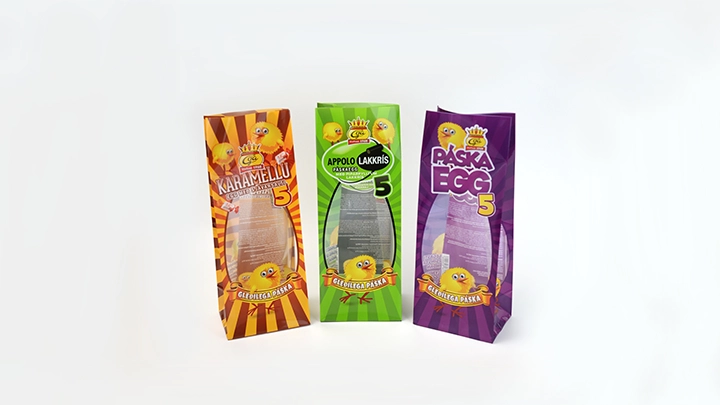
Our packaging product range includes block bottom bags, cross bottom bags, side gusset bags, box bottom bags, and doypacks for a wide range of food applications.
With over 25 years of flexible packaging industry experience, our team supports material selection, packaging structure development, custom printing, sample evaluation, and OEM/ODM production.
Customers can discuss suitable materials and packaging configurations based on product characteristics, filling requirements, target markets, and applicable food-contact specifications.
Conclusion
Food-grade packaging materials must be evaluated according to their intended food-contact conditions, material composition, regulatory requirements, and finished packaging performance.
BOPP, CPP, PE, PET, and paper-based materials offer different characteristics, but no single material is ideal for every food product.
Choosing the right packaging structure involves verifying food-contact suitability, required barrier properties, sealing performance, and production compatibility.
Looking for custom food packaging bags? Contact Fast Sincere with your product details, preferred bag structure, material requirements, and estimated order quantity to discuss suitable packaging options.